
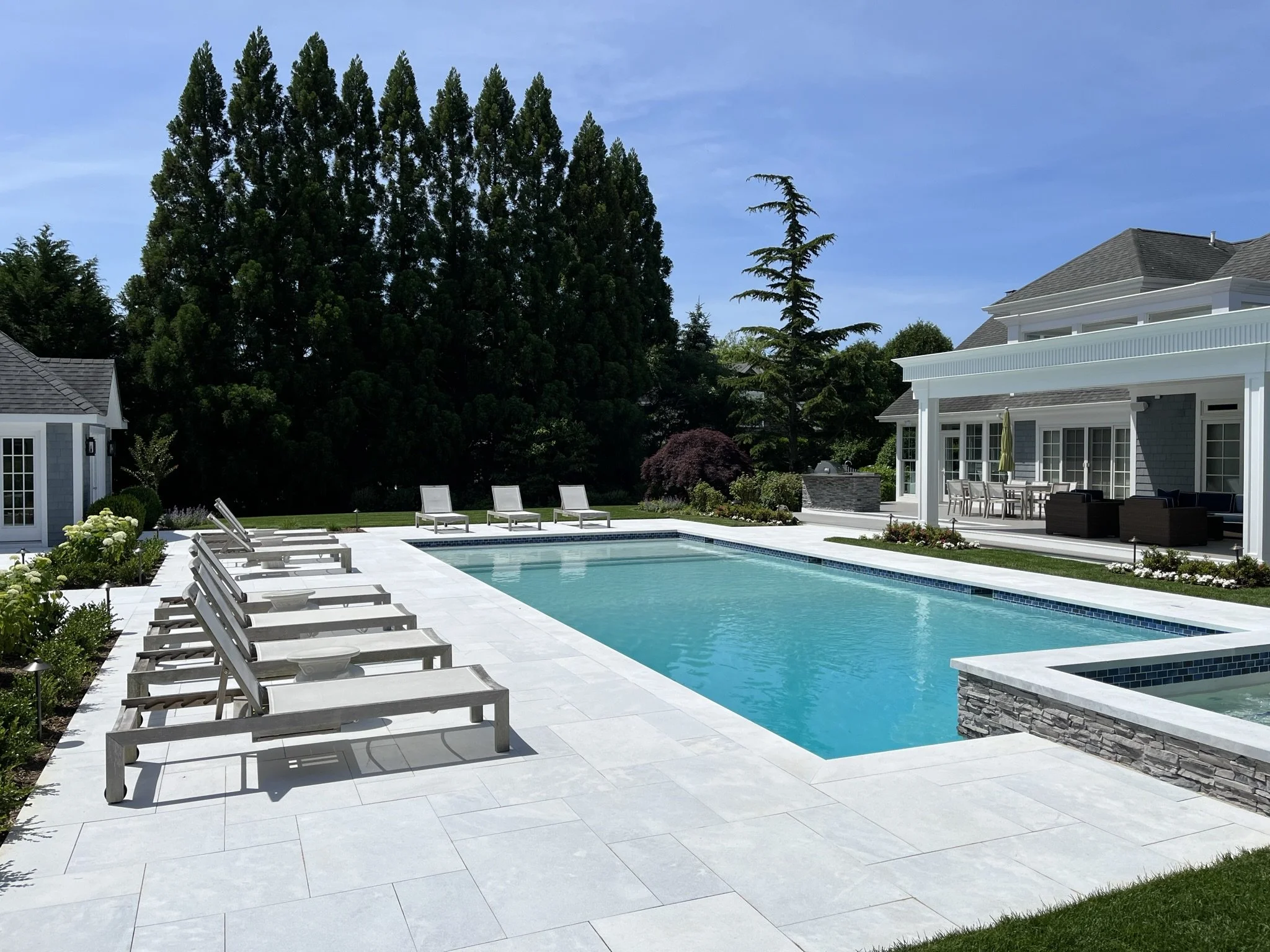
Buyers comparing pool proposals this year keep asking the same question, and it has little to do with tile samples. They want to know which week the water goes in. Gunite pool installation on Long Island, NY runs on a sequence of stages that each depend on the one before it, and the contract date sets everything that follows.
The Platinum Group designs and builds custom gunite pools across Long Island and the Hamptons, and our work has been recognized with Long Island Pool & Spa Association Design Awards and Unilock Awards of Excellence.
A dated calendar is as much a part of that work as the finished pool. What follows is the full build calendar our crews work to, stage by stage, so you can read any proposal in front of you with sharper questions.
Related: Top Gunite Pool Builder & Backyard Design Experts in Long Island, NY
What Gets Decided Before a Gunite Pool Is Dug?
Before a gunite pool is dug, design and engineering set the shell’s structural spec, the finished water line elevation, the equipment pad location and the long lead material orders. Our team starts with a survey of existing conditions, utility markouts, and a read on grade, drainage and soil, and those findings drive every one of those decisions. Compressing this stage to reach a faster start date moves the delay later in the build, where it costs more to absorb.
Design also decides lead times. Our approach to custom gunite pool design and construction locks material selections early, because coping stone, waterline tile, automation panels and heaters carry order windows that run weeks past plan approval. Our team places those orders while the permit package is still in review, since selections left open into spring are one of the most common reasons a pool misses its swim date.
A finished design package includes an engineered plan set, a plumbing and electrical layout, a grading and drainage plan, and a written sequence with dates attached. That last document is the one worth comparing across bids. Two proposals at similar numbers can sit four months apart on delivery, and only the calendar shows it.
How Long Does Pool Permitting Take on Long Island?
Pool permitting on Long Island generally takes six to twelve weeks for a clean application with no zoning issues, and longer where a septic review or a variance applies. Each town and village here runs its own building department, its own setback and lot coverage rules, and its own pool barrier code. Properties served by a septic system add a county health review that runs on its own clock.
Variances are where a project loses a season. If the pool, the deck or the equipment pad breaks a setback or pushes lot coverage past the limit, the application goes to a zoning board hearing that meets on a fixed monthly calendar, and two to three added months is a fair expectation once a hearing is required. Our team flags that exposure during design, so you can decide early between a redesign and a longer runway.
Electrical permits, barrier and fence compliance, and in some cases a separate drainage review run alongside the main pool permit. Those approvals are filed in parallel rather than in series, which is one of the few places a pool calendar can honestly be compressed.
What Do Pool Layout and Excavation Involve?
Pool layout and excavation mark the shape on the ground, confirm elevations, plan the equipment route and dig the pool, typically across one to three days plus haul time. Crews paint the shape, check elevations against the approved plan, and walk the route heavy equipment will take to the back of the property. On narrow lots the access route decides machine size, and machine size decides how many days the dig takes.
Rain is the variable that matters. Saturated soil stalls a dig, and a wet stretch in April pushes the entire sequence by ten days with a crew already mobilized.
Tree protection, neighbor notification and a plan for restoring the access lane belong in the contract rather than in a conversation after the machines arrive. Homeowners who have been through a bad project once tend to ask about this stage first, and they are right to.
Spoil volume is the detail that surprises people. A mid-size pool generates enough material to fill a long line of trucks, and on properties where the street cannot take staging, that haul becomes a scheduling problem of its own. Our team settles the staging plan before the first machine is booked.
How Do Steel and Plumbing Rough-In Set Up the Gunite Shell?
Steel and plumbing rough-in set up the shell by building the rebar cage and running every pipe and conduit before concrete covers them. Crews tie the rebar cage to the engineered spec, including bond beam reinforcement and any structural step for a raised spa, a tanning ledge or a vanishing edge. The cage is the structure of the pool, and it gets inspected before it disappears under concrete.
Plumbing rough-in happens inside the same window. Main drains, returns, skimmers, spa jets, autofill, the gas run to the heater, and conduit for lighting and automation are all installed and pressure tested while the excavation is still open. Anything you may want later, including integrated water features, is far cleaner to plumb now than to retrofit under a finished deck.
A pre-gunite inspection closes this stage. Steel placement, plumbing pressure and electrical bonding are verified and signed off before concrete is scheduled, and booking a gunite crew ahead of that sign-off is how a week disappears.
Why Does the Gunite Shell Need Time to Cure?
A gunite shell needs time to cure because the concrete gains strength over a stretch of days under a watering regimen, and loading it early causes cracking that shows up years later.
Gunite is concrete applied pneumatically against the steel cage under pressure, and a nozzle crew and finishers shape the floor, walls, steps and benches by hand as the material goes on. Most residential shells are shot in a single day, and that day is the most schedule-sensitive appointment in the build, because gunite crews book weeks out and a rain date pushes the whole line behind it.
Curing is the part people misread as downtime. Nothing structural gets loaded onto the shell during that window, and pushing tile, coping or deck work onto a green shell trades a week now for damage later.
Our crews use the cure window for work that does not touch the shell. Pool house framing, equipment pad forming, drainage runs and rough site grading all move during those days, so the calendar keeps advancing even though the pool itself looks untouched.
What Order Do Tile, Coping, Decking and Plaster Follow?
Waterline tile and coping come first on the cured shell, then decking and the surrounding hardscape, then plaster or another interior finish and the fill. Coping sets the finished elevation every deck material works to, so it lands before a single paver is laid. Mortar-set work is temperature sensitive, which matters far more in March and November than it does in June.
Pool Decking and the Surrounding Hardscape
Base preparation, drainage, edge restraint and the paving itself usually run two to four weeks depending on square footage and material. This is the stage where the site stops looking like a pool job and starts looking like a property, and where landscape design and construction, outdoor kitchens, fire features and lighting fold into the same crew schedule.
Pool Interior Finish and Fill
Plaster or a quartz or pebble interior finish is the last wet trade on the job. It goes on after the deck work that could chip or stain it is complete, and the pool is filled immediately after application. Start-up chemistry and daily brushing then run for roughly four weeks while the finish sets and the water balances.
Related: The Merrick, NY Guide to Integrating Gunite Pools Into Your Backyard Design

Which Inspections Punctuate a Gunite Pool Build?
A gunite pool build passes a pre-gunite inspection, an electrical inspection and a barrier inspection, and each one is a gate on the calendar rather than a formality. The first arrives before concrete, when steel placement, plumbing pressure and electrical bonding are checked against the approved plan. A failed check at that point costs days, because the gunite crew is already scheduled and the next open slot may sit a week out.
Electrical inspection follows the equipment set, covering bonding of the shell, the deck, the handrails and the equipment pad. Barrier inspection confirms the fence, the self-closing gates and any alarmed door that opens onto the pool area meet the code your town enforces. Those two carry the certificate that makes the pool legally usable.
Our project managers build the inspection lead times into the schedule rather than reacting to them, and they book each one as the preceding trade finishes. Homeowners get the dates in writing, which is the simplest way to tell a real calendar from an optimistic one.
Which Stages Are Weather Dependent and What Usually Causes a Delay?
Four stages on this calendar answer to the forecast: excavation, gunite, mortar-set masonry and interior finish. Each has a temperature floor and a limited tolerance for rain. On Long Island the shoulder seasons are exactly where those limits bite, which is why a March start and a June start behave differently even on identical plans.
The delays our team sees most often are not weather at all. A survey that arrives late, a variance nobody flagged during design, a utility upgrade needed for a gas heater, a tile selection left open into April, or a change order added after the steel is tied each cause them. Every one of those is inexpensive to prevent at the front of a project and expensive to absorb at the back.
Gunite Pool Work That Runs in Parallel
Several tracks move at once on a well-run job. Permitting for the hardscape, ordering of stone and tile, pool house framing, irrigation revisions and low voltage lighting design all advance while the shell cures and the deck base is prepared. Sequencing them as parallel tracks rather than a single line is what keeps a four month runway from stretching into six.
Equipment set and start-up close the build. The pad is plumbed and wired, the pump, filter, heater and automation are commissioned, final electrical and barrier inspections are scheduled, and the system runs under supervision before anyone hands you a remote and a maintenance schedule.
Why Does a Winter Contract Protect a Summer Swim Date?
A winter contract protects a summer swim date because the construction runway alone sits near four months before permitting is counted. Count backward from your target: interior finish and fill need roughly a month of start-up, decking needs two to four weeks, tile and coping need about a week on a cured shell, and gunite plus curing needs two to four more. Excavation through steel and plumbing adds another two to three weeks.
A contract signed in December or January puts the permit in review during the quietest weeks of the year, the dig in March or April, and the interior finish in May. The same contract signed in April lands the permit in June and the swim date in late August.
Early contracting also buys crew capacity. Trade partners, gunite crews and stone suppliers fill their spring calendars over the winter, and the projects that hold their dates are generally the ones that reserved those slots months ahead. Certainty is a scheduling decision more than a construction one.
Winter also gives design the room it needs. Survey work, engineering, material selection and the variance question all get answered without a crew idling, and the plan that reaches the building department is the one you want built. Projects that start their design in October behave very differently in May than projects that started theirs in March.
Book Your Gunite Pool Installation on Long Island, NY This Winter
Homeowners across Nassau and Suffolk who want a defensible schedule ahead of next season are better served starting the conversation now than in April.
The Platinum Group handles gunite pool installation as one accountable process, covering design, engineering, permitting, excavation, shell, hardscape and start-up under a single point of contact. We will walk your property, review the calendar stage by stage, and put a swim date on paper.
Call The Platinum Group at 516-212-1044 to schedule a gunite pool consultation.
In Summary
How long does a gunite pool take on Long Island between signing and swimming?
Most residential gunite pools The Platinum Group builds run four to six months between a signed contract and a filled pool, with permitting accounting for the widest variation. A zoning variance adds two to three months on top of that, which is why we test for it during design rather than after filing.
What usually makes a gunite pool schedule slip once construction has started?
A gunite pool schedule usually slips because permit or variance review runs past its estimate, a weather window closes on the shell or the interior finish, an inspection is booked later than the trade that feeds it, or long lead coping, tile, heaters or automation arrive behind the dig. A dated calendar makes any of those visible weeks ahead of the stage they hit, so our Long Island crews resequence the parallel work and reorder materials while there is still room to absorb it.
What approvals does a pool need before the dig?
A pool needs a building permit from your town or village, an electrical permit and barrier compliance at minimum before the dig. Properties on a septic system also need a county health department review, and any setback or lot coverage conflict adds a zoning board hearing to the schedule.
What happens in the first two weeks after we sign?
The first two weeks after signing cover the survey, utility markouts and a site visit, followed by the engineered plan set, the drainage plan and the permit filing. Material selections are locked in the same window so long lead items are ordered well before excavation is scheduled.
Related: Consider a Gunite Pool for a Fully Custom Landscape Design in the Brookhaven, NY Area